
Product Launch
Introducing Argus Continuum: Youth Services Budget and Referral Management
February 2026
Argus Continuum is a web-based platform for managing youth services funding, detention screening, service referrals, provider billing, and compliance monitoring across multiple judicial districts.
State youth services divisions face a recurring operational challenge: coordinating funding, screening, and service delivery across multiple judicial districts, each with their own provider networks, budget constraints, and operational practices. In most states, these processes are managed through a combination of spreadsheets, email, and disconnected systems. Budget submissions arrive in inconsistent formats. Screening data is recorded differently across districts. Referral tracking depends on individual staff practices rather than standardized workflows.
The result is limited visibility at the state level, inconsistent service delivery across districts, and difficulty demonstrating how funding connects to outcomes. When the legislature or federal oversight bodies request data on youth served, services provided, or dollars spent, producing accurate statewide numbers requires significant manual effort.
Multi-District Budget Management
Continuum provides a structured annual planning process where each judicial district submits budget requests through the platform. Districts build their budgets by service type and line item against configurable service taxonomies. State administrators review submissions, request modifications, and approve final allocations through documented workflows.
Once budgets are approved, the platform tracks expenditures against allocations in real time. District fiscal staff see remaining balances by service category. State administrators see utilization rates across all districts and can identify underspending or overruns before they become problems. Mid-year adjustments and reallocations are processed through the same approval workflow as initial budgets.
Standardized Detention Screening
The platform implements a configurable detention screening instrument that produces a risk level from 1 through 5 based on current charges, prior referral history, supervision status, and aggravating factors. The scoring weights and thresholds are configurable by state administrators, allowing the instrument to be calibrated without code changes.
In addition to the risk score, a statutory detention questionnaire identifies cases where detention is mandated regardless of the calculated risk level. Override workflows allow authorized staff to deviate from the screening recommendation with documented justification and supervisor approval. All screening decisions, overrides, and dispositions are recorded with full audit trail for quality assurance and reporting.
Referral Lifecycle Management
Continuum manages the full referral lifecycle from intake through service delivery and closure. When a youth is referred for services, the platform matches available providers based on service type, district, capacity, and eligibility criteria. Referrals are assigned to providers, authorized for specific service units, and tracked through delivery and outcome recording.
Case managers document progress notes, service contacts, and status changes within the platform. Providers update service delivery records that feed directly into the billing process. When a referral closes, outcome data is captured for reporting. The connection between referral, service delivery, and billing is maintained throughout, so the state can trace individual expenditures back to specific youth and service episodes.
Billing Controls and Provider Management
Providers submit invoices through the platform against authorized referrals. The system validates that billed services match authorized service types and units, that rates conform to the applicable rate schedule, and that the total does not exceed the authorized amount. District fiscal staff review and approve invoices before they are processed for payment.
Provider management includes credentialing workflows, contract tracking, service capacity management, and performance monitoring. State administrators maintain the provider network configuration including approved service types, rate schedules, and compliance requirements. Provider compliance status is tracked and surfaced during the referral assignment process.
Statewide Reporting and Oversight
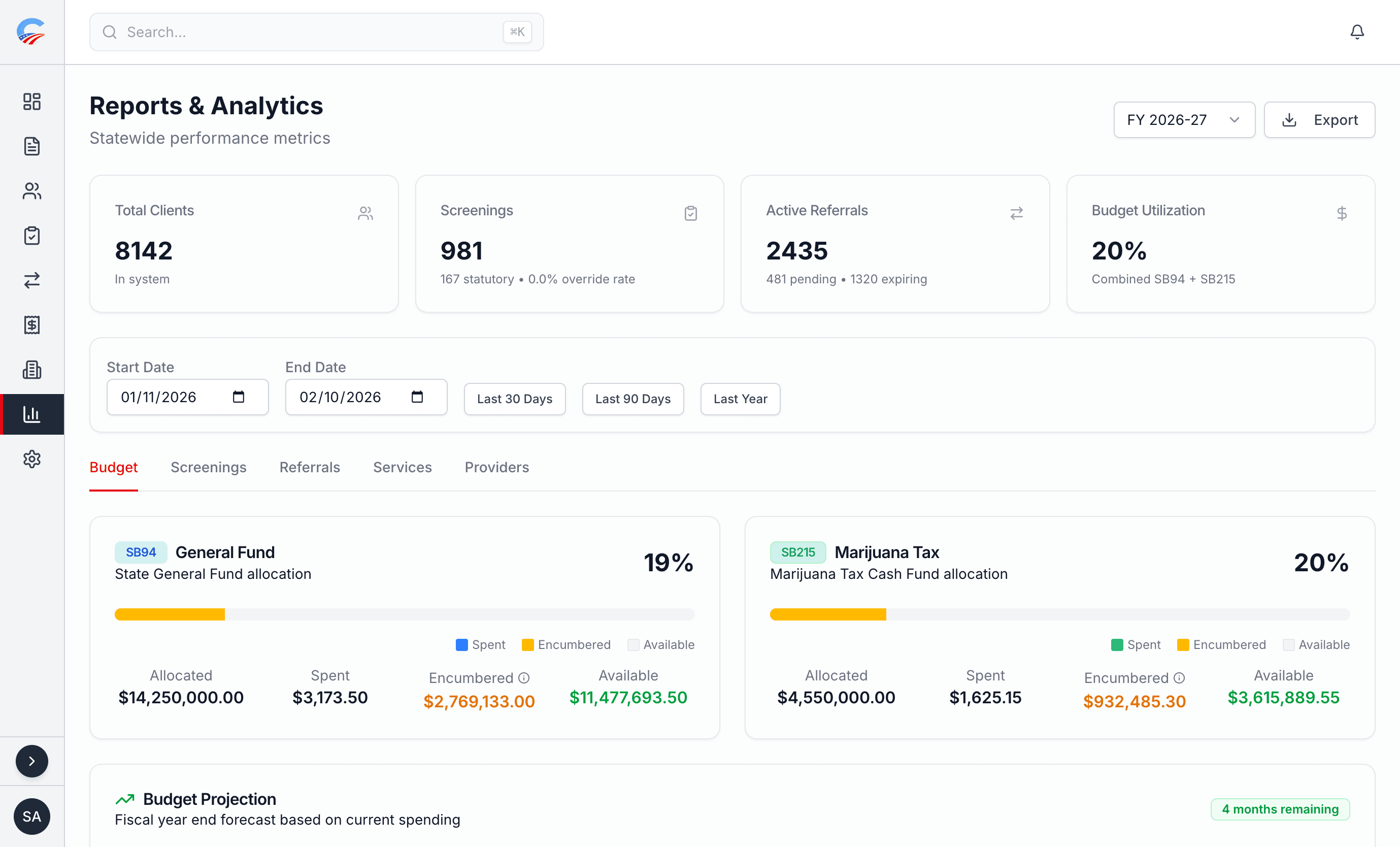
Because all districts operate on the same platform with standardized data structures, statewide reporting is produced from a single source of truth. State administrators access dashboards covering budget utilization by district, screening volumes and outcomes, referral trends, provider performance metrics, and expenditure analysis.
Reports can be filtered by district, time period, service type, and provider. Export capabilities support legislative reporting requirements and federal data submissions. The platform maintains historical data across fiscal years, enabling trend analysis and year-over-year comparisons without manual data consolidation.
Learn more about Argus Continuum for your state.